
|
The Artiste was the last generation of several player systems offered by Möller. It was inspired by a single contract for a large commercial organ in Buffalo NY that included "a fully automatic player with 100 rolls." This required that Möller come up with a new system comprehensive enough to satisfy the client. Möller engaged Frederick Hoschke and Leonard Peloubet to design the player system and execute the required 100 roll titles. When this project was completed, Möller and Hoschke decided to offer this system to the market. This story is well documented by Jim Weisenborne. You can find here:
Note that there are a couple details in the article that are incorrect. The roll library list is not quite accurate and the operation of the Crescendo is slightly incorrect.
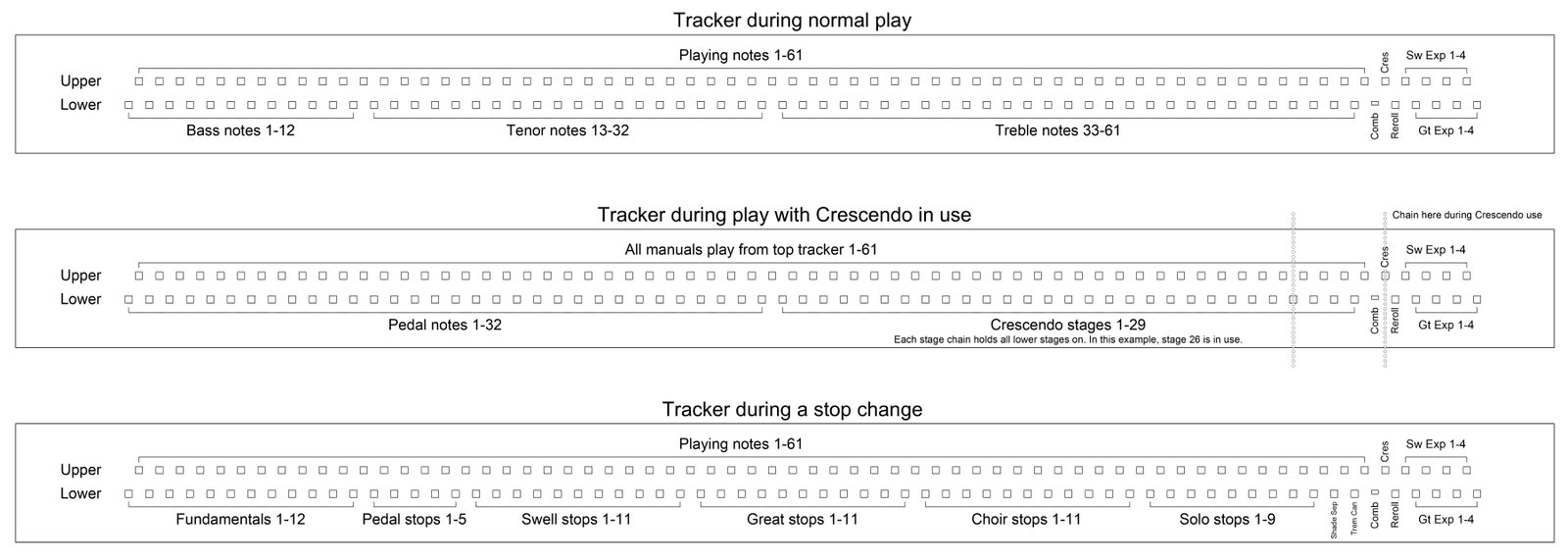
When the Crescendo function is required, Upper Tracker port 62 is opened and held open with a chain perforation for as long as the Crescendo function is in use. At the same time, another chain is opened on one of the Lower Tracker ports 33-61, depending on the stage needed. The Weisenborne article incorrectly states that the stage ports are on the Upper Tracker.
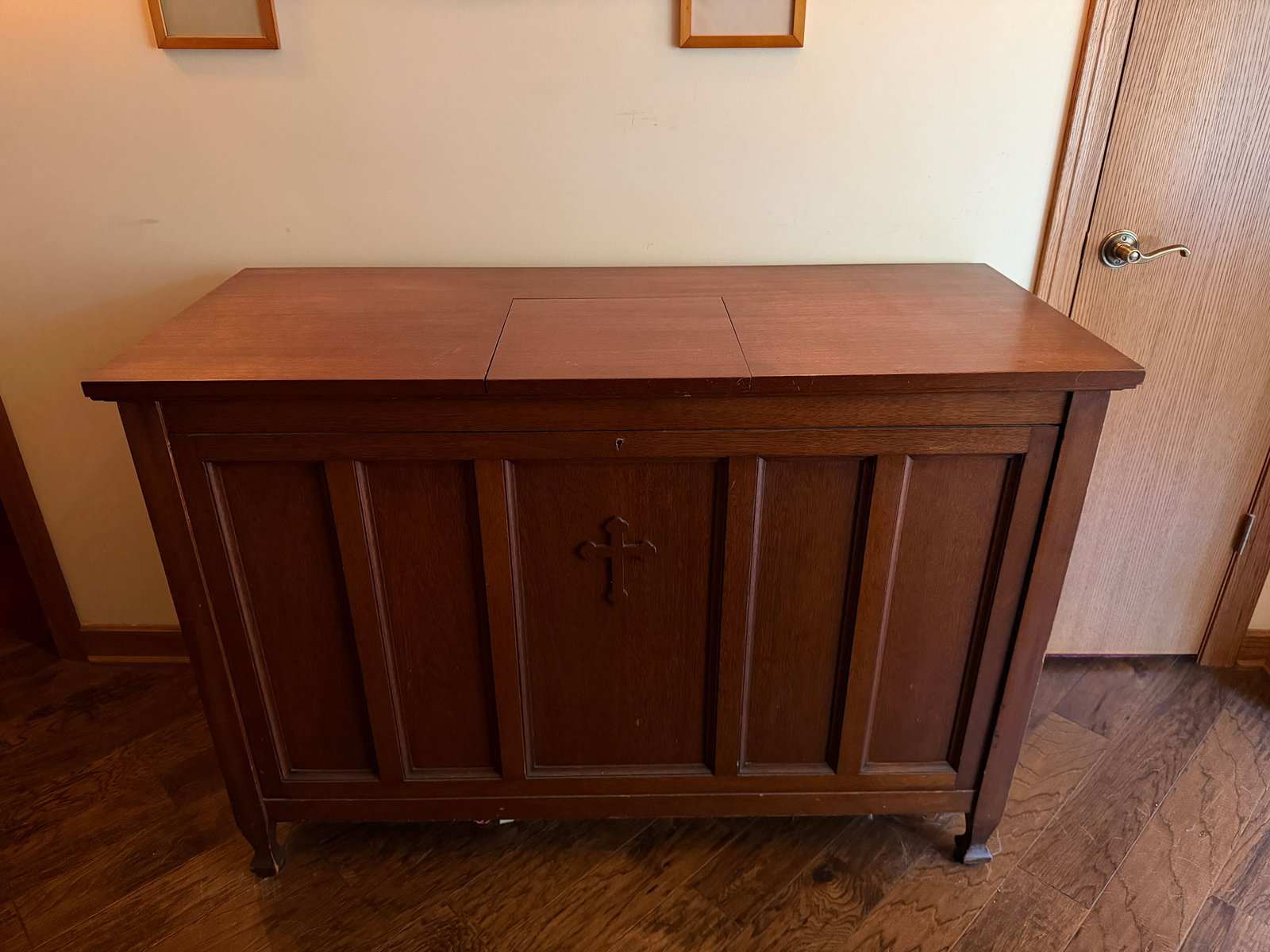
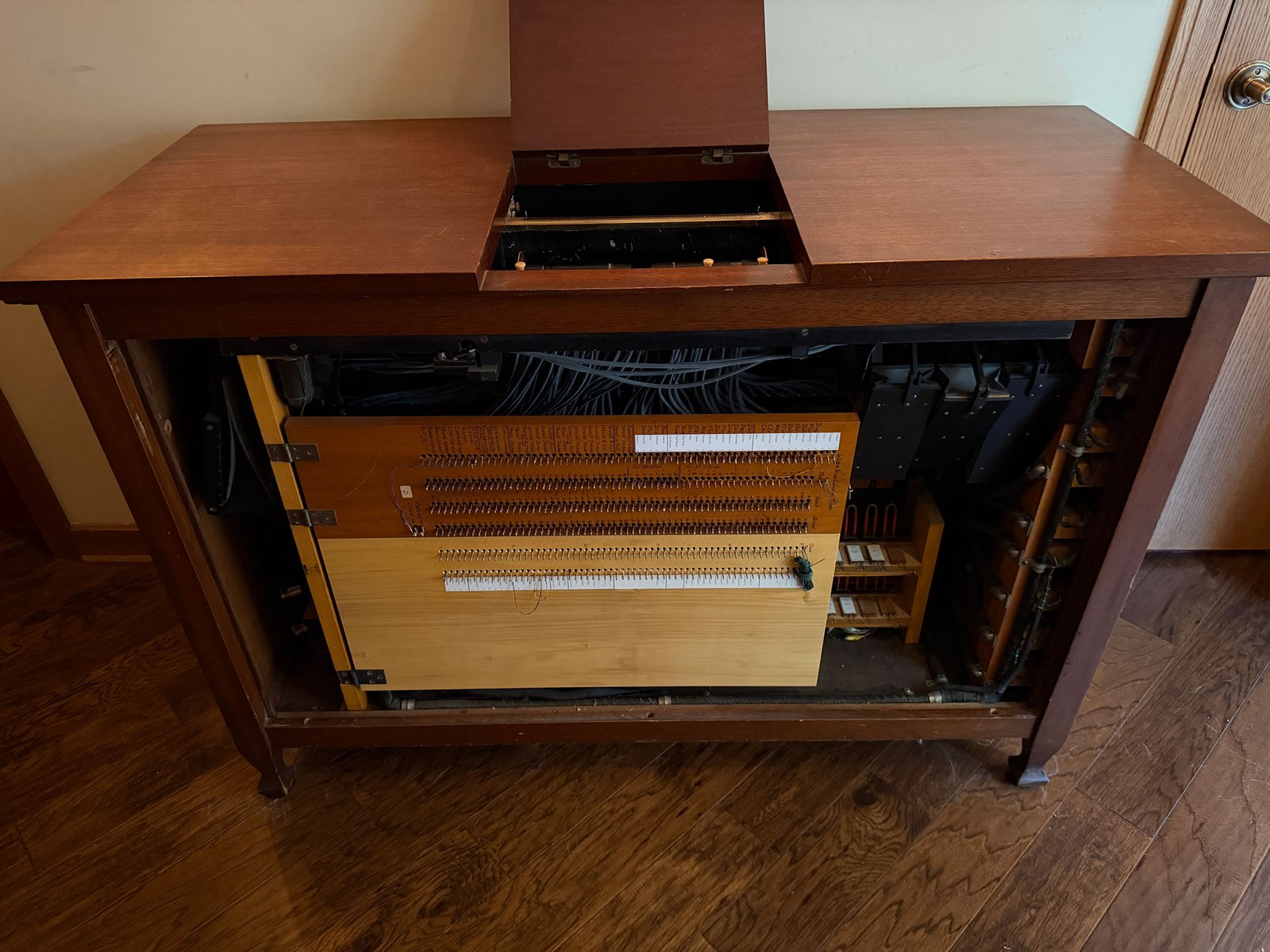
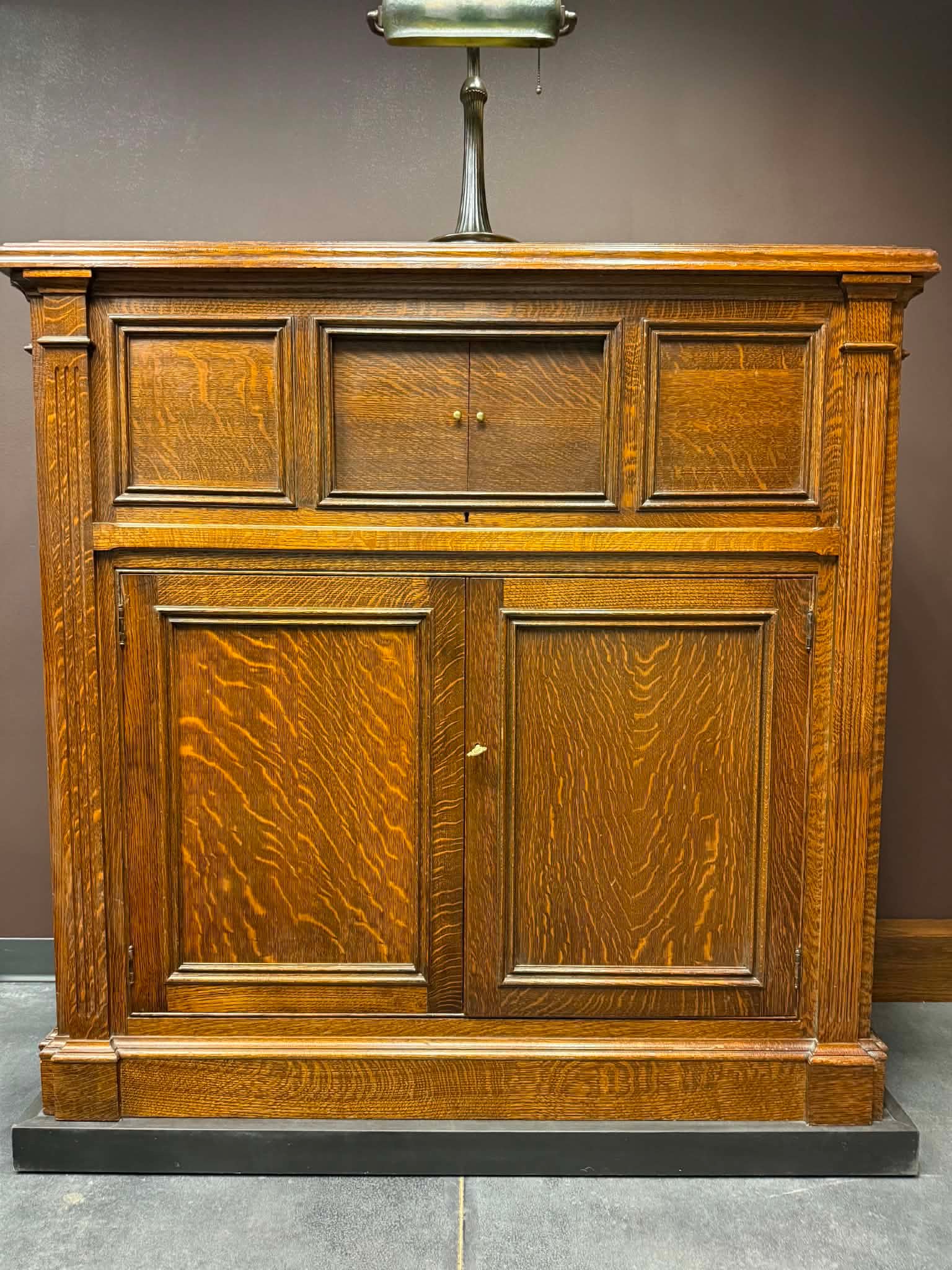
The Artiste is one of the few player systems that is completely self-contained. Each player cabinet or console has the entire player system, usually including the pump, contained within the cabinet. (Most player systems required significant remote equipment housed elsewhere.) This allowed the Artiste to be more easily added to existing organs. Electrical connections were all made parallel to the console connections. Möller made standard and custom cabinets. The standard cabinets were a front loading upright, a top loading buffet, and a top loading kneehole desk. They also sometimes built them into building walls. Here are some examples:
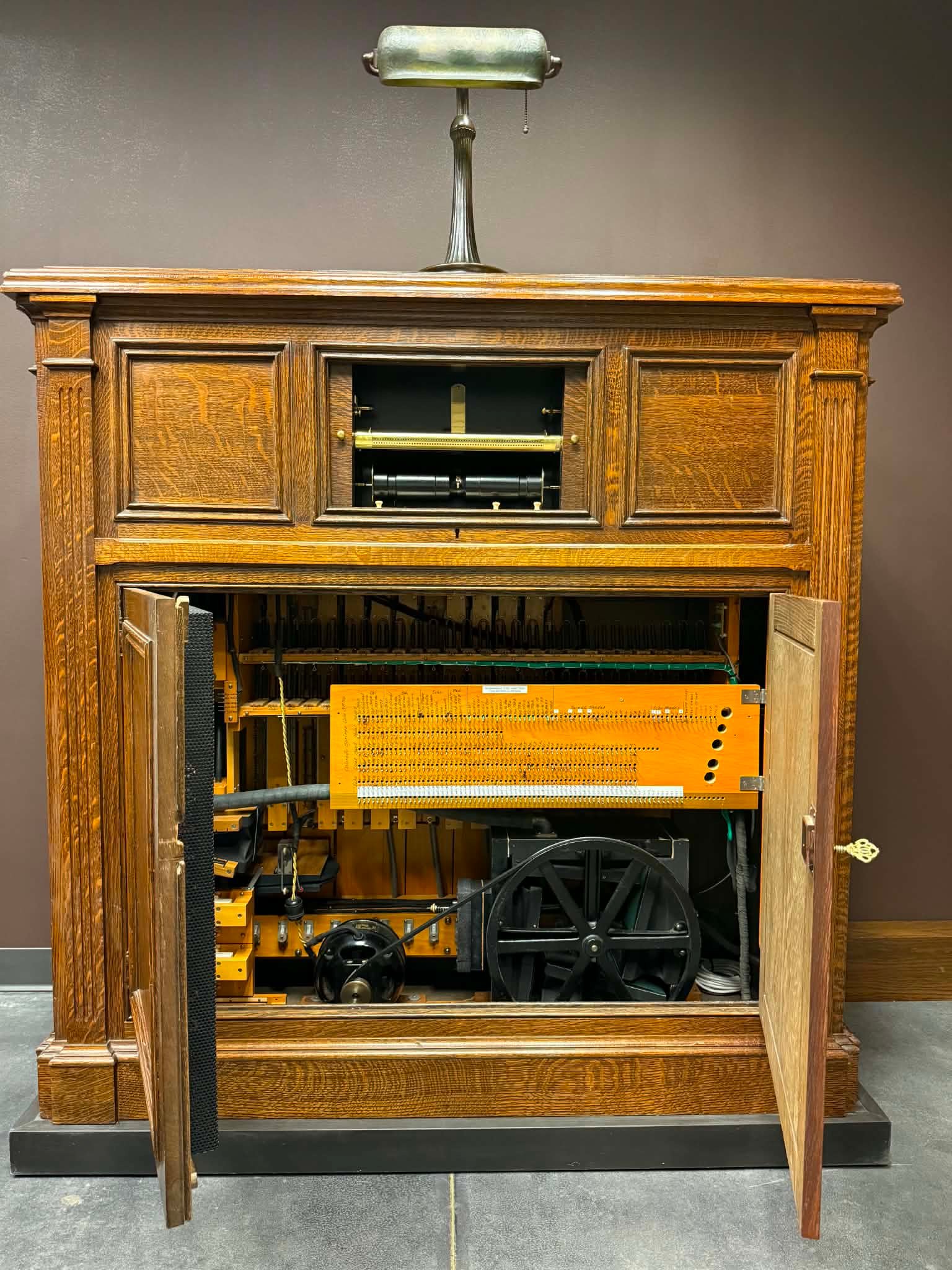
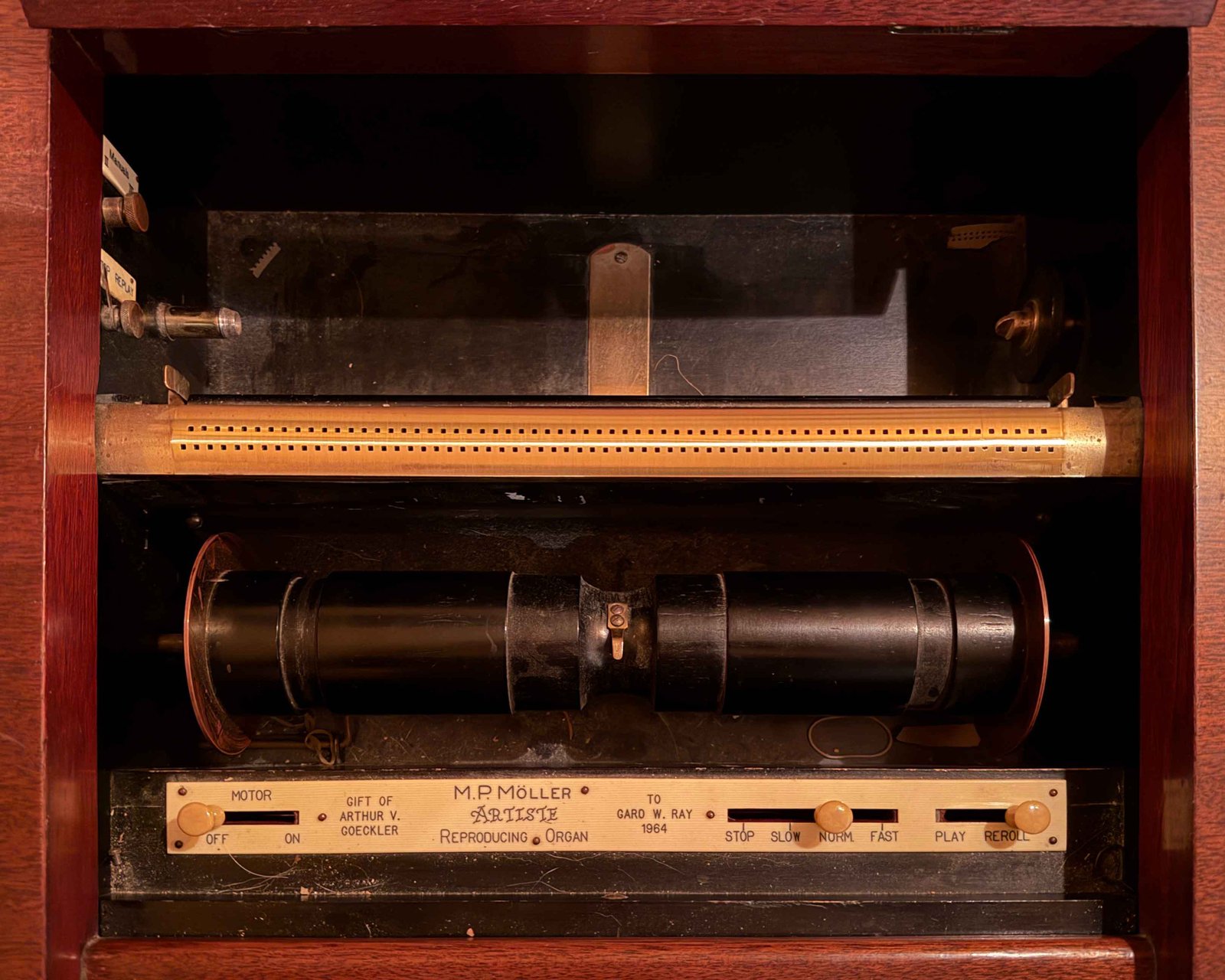
The Artiste spoolbox controls are unique. Speed is standard at Normal. Some long-playing rolls have an indication to place the Tempo control to Slow. According to the test roll, Normal is approximately 85 or 8.5 feet per minute.
The Artiste can play up to 4 independent musical lines simultaneously, thanks to its unique tracker bar layout. During normal play, the tracker bar is divided into 4 sections, each of which can be coupled to a different division of the organ. The Upper Tracker is one section of 61 notes that can play any manual as needed. The Lower Tracker is divided into 3 sections called Bass, Tenor and Treble. Different divisions of the organ can be coupled to these sections of the tracker bar. The assignments of which division is played by which tracker section is selected by the Fundamentals during a stop change. For example, the Pedal may play from Lower Tracker Bass, the Choir can accompany from Lower Tracker Tenor, the Swell can play melody from Lower Tracker Treble, and the Great Harp can play arpeggios from the Upper Tracker. Frederick Hoschke was a brilliant organist, composer, conductor and engineer. He was able to take advantage of the capabilities of the system he designed, rendering orchestral transcriptions that used the organ far beyond what a single human could, and he took particular pride in doing so. His large symphonic transcriptions are some of the best titles in the library. During a stop change the Combination port is opened. When this port opens, a lot happens in a fraction of a second. All playing notes on the Lower Tracker are muted. The Lower Tracker ports 1-61 are switched to stop control. All previously held stops and Fundamentals are canceled. New stops and Fundamentals are then set on ports 1-61 as needed. The Combination port closes and all Lower Tracker ports are again returned to (the new) playing notes. If the Fundamentals and stops affecting the Upper Tracker are not changed during a stop change, playing notes on this Tracker can continue through the stop change. While technically the notes of the Upper Tracker may drop out momentarily, it happens quickly enough to not interrupt the music. One unique feature of the Artiste was that stops were customized for each client. The marketing people liked this as it gave them a selling point on the competition. Each roll was registered at each stop change according to the stops on a particular organ. These were chosen by referencing the registration defined by the Möller Studio organ as an ideal, with substitutions made accordingly to produce the best musical result. Essentially, each roll was custom registered for a particular organ. The issue that arises for contemporary collectors is that the rolls that may be added to a collection may not play well or at all on a player that is different from that for which they were made. The Möller company had a great deal of new old stock rolls on the shelves in the 1960s and 1970s, some of which had been pre-registered and many of which had no registrations at all. These rolls were sold to many collectors and are now circulating on the open market. These will almost certainly not work well on a given player. Charles Kegg is offering services to re-register existing rolls. Please contact him should you need Artiste rolls re-registered. He has all the factory records and the registration machine for this work. Here are photos of the original Registration Machine and an example of a stop change in a roll.
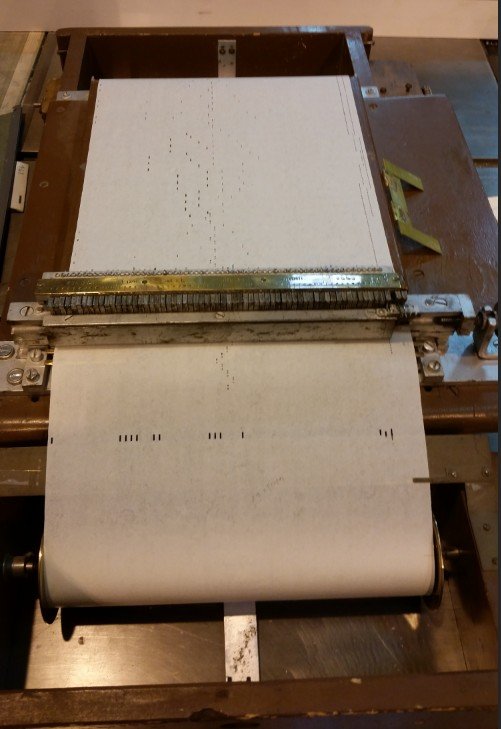
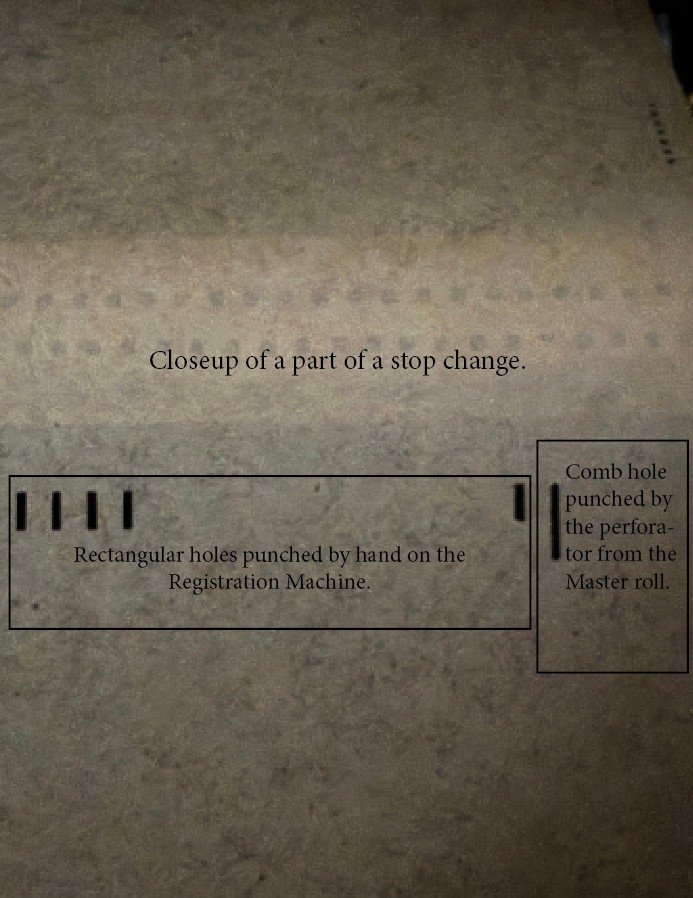
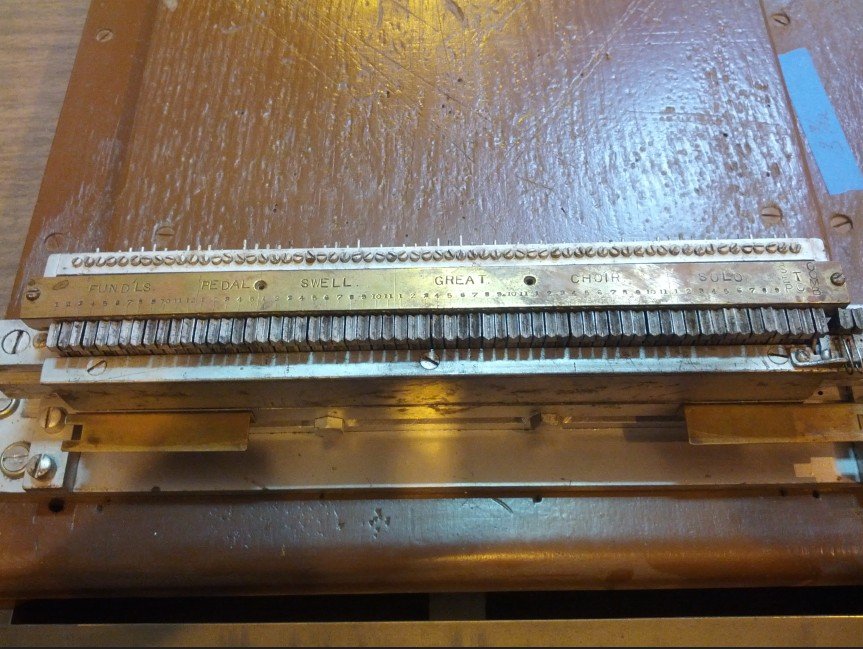
For the standard Artiste, there was an ideal stop compliment spread out over 3 manuals and Pedal. This was known as the Studio spec and the stop combinations for each stop change on a roll assumes this complete spec. When a roll was purchased, the stops were cut into the roll by hand on the Registration Machine, tested and then sent to the client. If a client had a 3 manual organ, the stops were usually cut to exactly the Studio spec. Every Artiste had enough relays to cover all the combinations for each division, so even if a 3 manual player was missing a stop, there was a relay that would turn on something musically appropriate. The larger problem came with 2 manual players that did not have a Choir division at all. Changes would have to be made to stop selections to keep the music reasonable. This was especially true of Studio stops that might be on a given organ, but in a different division. For example, when a 2 manual organ had no Choir division, and the Studio spec called for the said stop to be on the Choir, changes in Fundamentals would also have to be considered to make the available stop to play from the correct part of the tracker bar. If these things are not right, the Artiste playing a roll not made for it can play some very odd and awkward-sounding music. Large organs with a Solo or Echo division could be addressed, and these were always special. To register rolls for an Artiste player, one must have the Möller registration records and know the music and the particular player well.
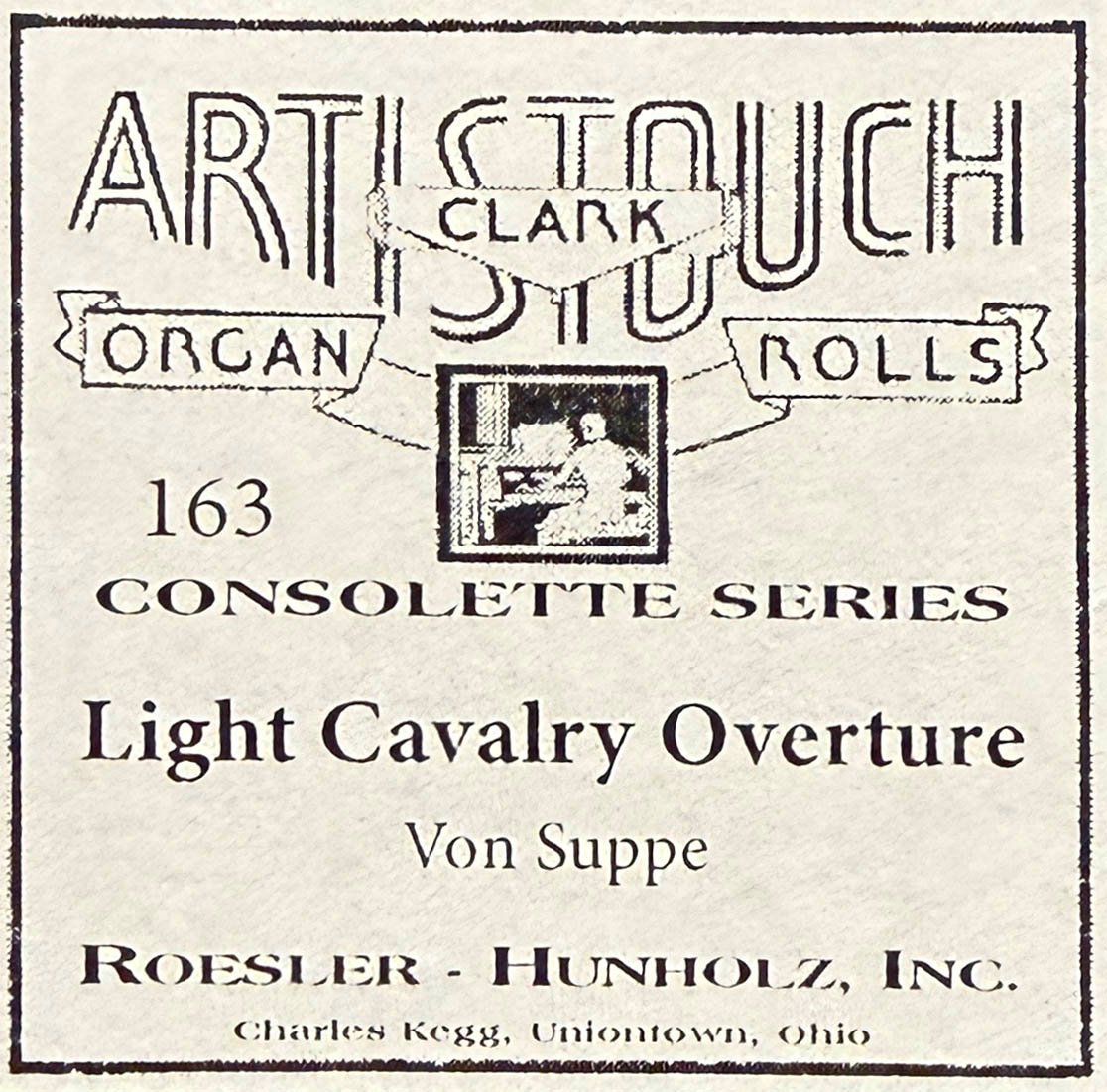
The Artiste roll catalog is available by clicking below. Please note that some titles appear to have been assigned a roll number; but never issued. This is still being researched and will be updated here as new information is discovered.
Tips and Tricks The Artiste system is well-designed and quite robustly built. Properly restored, it will give years of reliable service. There are a few tips I will share that may make living with an Artiste a bit easier. 1. When restoring an Artiste I recommend you retain all the mechanical switching and resist the urge to replace it with electronic switching. The timing of the stop changes is critical and adjustable in the original system. Electronic switching can actually be too fast, resulting in musical hiccups. All playing contacts are silver and the machine will work well when original outputs are sent into an organ electronic switching system. 2.When restoring an Artiste, be particularly careful in the treatment of the switches. These must move with quick precision. You will note that the Combination switch is different from the others. This switch is mission-critical. It has extra springs on it and is fed air at both ends from twin valves. This is to give it the increased speed it needs. The electric relays in the base of the player lock in the stops, Fundamentals and Crescendo steps. For stops and Fundamentals, there is one finger on each relay that sends a signal through a position on the Combination switch and then goes back to the same relay coil. The Combination switch is normally closed and held closed by the Kicker switch. With the Combination switched closed, through the above described wiring loop, each magnet will hold itself ON as long as the Combination switch remains closed. The Kicker switch is enclosed in a little black box, usually adjacent to the spool box. The Kicker switch is energized by the Combination port. When energized, the magnet plucks the normally-closed contact, briefly opening it.
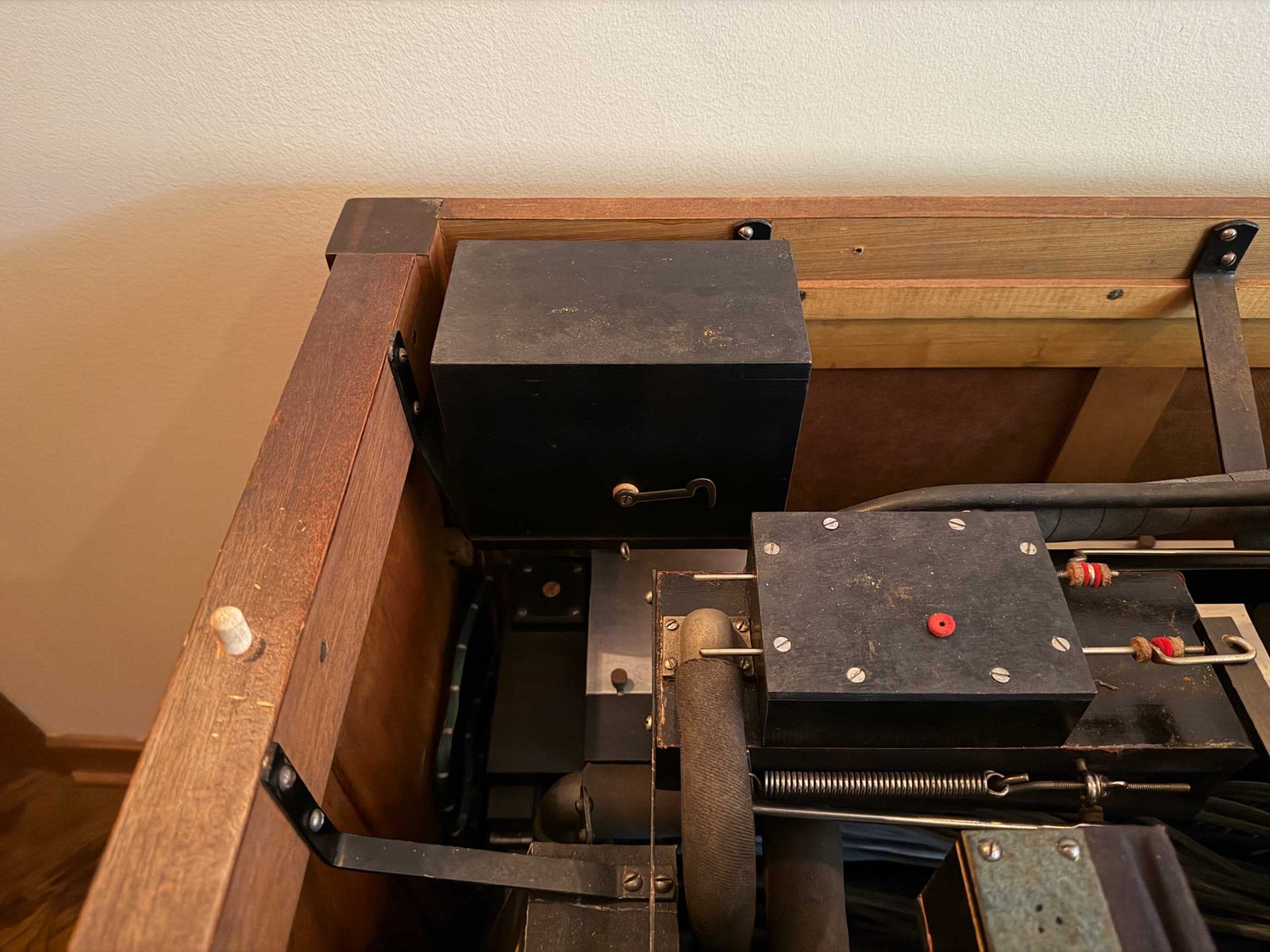
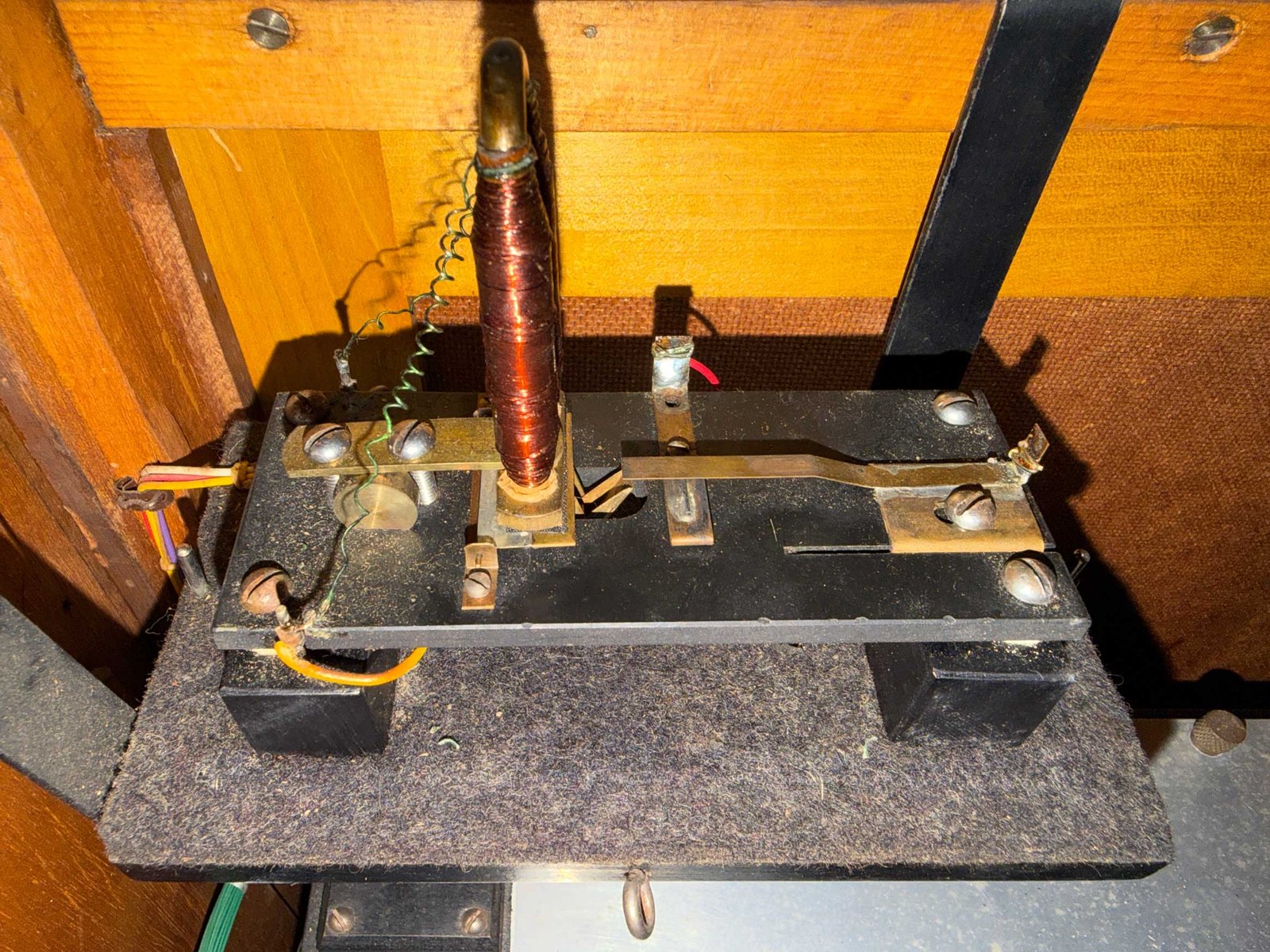
Kicker switch box & switch During this moment, the Combination switch must break cleanly and completely and immediately remake. The brief time the Combination switch is open allows the Fundamental and stop relays what were set to drop out. Proper function of this operation relies on the Combination switch to move quickly and precisely, and the Fundamental and stop relays to move quickly in both directions. For the relays, this is usually not an issue. (See note 3 below.) Note also that the twin valves feeding the Combination switch each have a magnet. These are normally energized and only turn off very briefly during a stop change. This means that as long as the organ is on, these magnets are energized. Due to this, these magnets can become partly permanently magnetized. If this happens, an otherwise perfect Combination switch can become slow. Magnet replacement is best if this is found to be an issue. You can also consider rewiring the key feed to the Kicker switch from a source that is only energized when the player is actually running. This will eliminate permanent magnetization in the future. 3. The electric relays used for the stops and Crescendo are very reliable. However, they have one flaw. There is a coil of wire that feeds keying polarity to the maker bar. This coil can break at either end. If a stop or Crescendo stage does not work, look for this issue. When adjusting the relays, it is tempting to stretch the coil and arrange it such that it is looped up between the magnet coils and then back down to the maker bar. This allows the wire coil to encourage the maker bar to drop quickly when the Combination switch opens. Indeed, many players have these coils shaped this way, and work well. Remember that this coil has keying voltage to it at all times, and it moves with each movement of the relay bar. If the coil rubs on an adjacent magnet coil at all, it can rub through the insulation and energize the adjacent coil. If a relay is always locked on or occasionally comes on "on its own," look for this issue. 4. Some owners have experienced that the Artiste will "blip" during a stop change, meaning notes momentarily play when they shouldn't. This is usually caused by the stop holes remaining open briefly after the playing notes have been unmuted at the end of a stop change. This can sometimes be corrected by adjusting the end-travel screw of the Combination Cut-Out switch so that it opens farther. This would mean turning the screw out. This will cause the switch to have to move farther when going back on, thus retarding the time to return the Lower Tracker to playing notes. There are some rolls that have the stop holes punched into the roll at slightly the wrong place and will always blip at that particular change. If you have a single roll that always blips on the same stop change, and other rolls do not, then cut the Combination hole for that change a very small amount higher on the roll, holding the Combination port open slightly longer. This will assure that the stop holes have completely passed before the Lower Tracker is returned to playing notes. 5. The Artiste stack is an almost masterful design that is very well executed. The leather pouches were all rubberized and I have never seen one fail. Unfortunately replacing these pouches points out the rather severe flaw in the design. Renewing this leather will require taking the stack apart at the gasketed point where all the contacts exit the box. While possible, I suggest you do not attempt this unless you deem it absolutely necessary. The usual stack is in 4 sections that hinge apart. Each section has an aluminum cover plate held by thumb screws. The bleeds are under a thin cover that runs the length of the stack section. The author has seen one example of a very different stack, so there are exceptions. 6. It may surprise owners to know that the Artiste stack assembly includes primaries. This accounts for the extreme speed of repetition. These primaries are rather well hidden under black covers with internal clips to hold them in place, and are easily overlooked. The covers are above the tubing nipples and slide out to the rear in the direction of the nipples, with no visible fasteners. If you have a cyphering note, check for debris under a primary that will be hiding under a cover. A clue is such debris may cause a noticeable vacuum leak. 7. Most Artistes have similar interior layouts. However, each machine was custom-built and there can be significant variations. This is particularly true of players for large organs. These can have special switching for ancillary divisions and also for expression. But the underlying mechanism will always be the same, except for one model of player for very small organs. See note 8. 8. The Artiste assumes that the attached organ will have division key circuits for manuals and Pedal. This means that from the player there is one Pedal key output of 32n, and the organ will have a Pedal relay to take these note signals. Thus, even small Möller organs built with an Artiste will have a Pedal relay. There is one exception. Möller made some very small standard spec organs for homes and mortuaries, usually only 3 ranks, on which they saved money by not using a note relay. These have all the switching in the player and play the ranks directly. These players use a completely different stop layout and do not use Fundamentals at all. I strongly recommend that you do not attempt to use one of these players for a project. They can only address 3 or 4 ranks and are not easily expanded. There are many "normal" Artistes out there that will be a better choice. |